
Can WhatsApp Messages Be Used as Evidence in Court? Full Analysis
TL;DR:
- WhatsApp messages can be valuable court evidence when they are authentic, complete, relevant, and legally obtained.
- Whether you use screenshots, exported chats, original device data, or recovered messages, preserving the original information and documenting how it was collected can help strengthen its reliability.
- If you need to recover deleted conversations, such as WhatsApp chats from one year ago, your chances will depend on available backups, device storage, and whether the data has been overwritten; no recovery method can guarantee success.
NOTE: We recommend backing up relevant WhatsApp evidence on your own phone and avoiding saving or accessing chat content stored on other people's devices for personal use. Thank you for your cooperation.
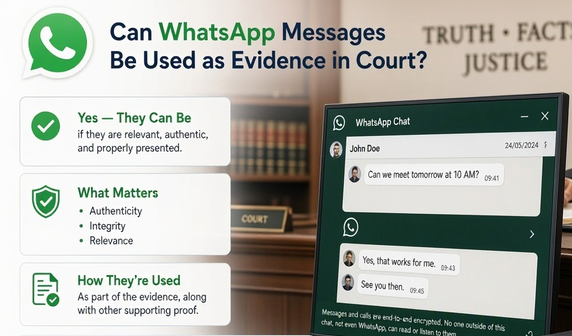
WhatsApp messages often contain important conversations, agreements, and other information that may become relevant in legal disputes. This raises an important question: Can WhatsApp messages be used as evidence in court? In this article, we'll explain their legal admissibility, the requirements for reliable digital evidence, and how to preserve or recover WhatsApp messages for potential court use (Can I recover 1-year-old WhatsApp chats?).
- Part 1. Are WhatsApp Messages Legally Admissible in Court?
- Part 2. What Types of WhatsApp Messages Can Be Used as Court Evidence?
- Part 3. What Makes WhatsApp Messages Valid and Reliable Evidence?
- Part 4. How to Preserve WhatsApp Messages for Court Proceedings?
- Part 5. Can Deleted WhatsApp Messages Be Used as Evidence in Court?
- Part 6. Common Mistakes to Avoid When Using WhatsApp Messages as Court Evidence
- FAQs about WhatsApp Messages as Court Evidence
Part 1. Are WhatsApp Messages Legally Admissible in Court?
Yes. WhatsApp messages can be used as evidence in many countries, including the US, UK, and Saudi Arabia. They may help prove agreements, financial transactions, workplace disputes, threats, or other relevant matters. However, admissibility depends on local laws and whether the messages are authentic, relevant, complete, reliable, and legally obtained.
1.1 WhatsApp Messages as Evidence in the US
In the US, WhatsApp messages may be admitted in civil and criminal proceedings under applicable evidence rules. Courts may also consider hearsay rules, relevance, and supporting evidence. For example, WhatsApp conversations confirming a debt or business agreement may support a legal claim when accompanied by payment records or witness testimony.
1.2 WhatsApp Messages as Evidence in the UK
UK courts may accept WhatsApp messages in civil, family, and employment proceedings. Their reliability may be assessed through the original device, phone numbers, timestamps, account information, and supporting testimony. Keeping complete conversations rather than isolated screenshots can help establish context.
1.3 WhatsApp Messages as Evidence in the AU
In Australia, WhatsApp messages may be used as evidence in civil and criminal proceedings if they meet applicable evidentiary requirements. For example, WhatsApp conversations may help prove business agreements, payment arrangements, or other legal matters.
1.4 WhatsApp Messages as Evidence in Saudi Arabia
Saudi Arabia recognizes digital evidence under its Law of Evidence. WhatsApp conversations may support legal claims involving business agreements, financial transactions, and other disputes, provided they meet applicable evidentiary requirements.
1.5 WhatsApp Messages in Employment Court Cases
WhatsApp conversations may help establish facts in employment disputes involving:
- Unfair dismissal and disciplinary actions.
- Workplace harassment and threats.
- Unpaid salaries and bonuses.
- Working hours and job responsibilities.
- Employment agreements and salary promises.
You May Also Like: Can Facebook Retrieve Deleted Messages for Court? In-depth Handbook
Part 2. What Types of WhatsApp Messages Can Be Used as Court Evidence?
Different types of WhatsApp content may help support a legal claim:
- Text messages: Agreements, promises, admissions, and instructions.
- Photos and videos: Images documenting accidents, property damage, transactions, or incidents.
- Voice messages: Audio containing verbal agreements, threats, or important statements.
- Documents and attachments: Contracts, invoices, receipts, and business records.
- Group conversations: Discussions involving business partners or multiple participants.
- Timestamps and message details: Information helping establish when communications occurred.
Preserve original files and relevant conversations to maintain their context and reliability.
Further Exploration:How to Manage WhatsApp Account on Android? Suggestions & FAQs
Part 3. What Makes WhatsApp Messages Valid and Reliable Evidence?
Courts may consider the following factors when evaluating the authenticity and reliability of WhatsApp messages:
|
Key factor
|
Explanation
|
How to ensure reliability
|
|
Authenticity
|
Proves that messages genuinely came from the claimed sender. |
Keep phone numbers, account details, and the original device. |
|
Integrity
|
Ensures messages have not been edited or manipulated. |
Preserve original conversations and avoid modifying files. |
|
Completeness
|
Provides sufficient context for understanding the conversation. |
Keep relevant messages, replies, timestamps, and attachments. |
|
Chain of custody
|
Documents how evidence was collected, transferred, and stored. |
Record collection dates, storage locations, and anyone handling the files. |
Part 4. How to Preserve WhatsApp Messages for Court Proceedings?
To protect potentially important WhatsApp evidence:
- Keep the original conversations on your phone.
- Take screenshots showing relevant messages and timestamps.
- Export important chats using WhatsApp's built-in feature. (Want to export WhatsApp media to a hard drive?)
- Save original photos, videos, voice notes, and attachments.
- Maintain available Google Drive or iCloud backups.
- Avoid resetting your phone or deleting relevant data.
- Consider professional forensic examination for important disputes.
4.1 Screenshots vs. Exported Chats vs. Forensic Extraction
|
Method
|
Best for
|
Main Advantages/Drawbacks
|
|
Screenshots
|
Selected messages |
Easy to capture/Can be edited or cropped |
|
Exported chats
|
Complete conversations |
Readable and convenient/Does not independently prove authenticity |
|
Original device
|
Source verification |
Retains original data/May require technical examination |
|
Forensic extraction
|
Disputed evidence |
Provides detailed technical information/May require professional assistance |
4.2 Export WhatsApp Messages on Android/iOS Locally
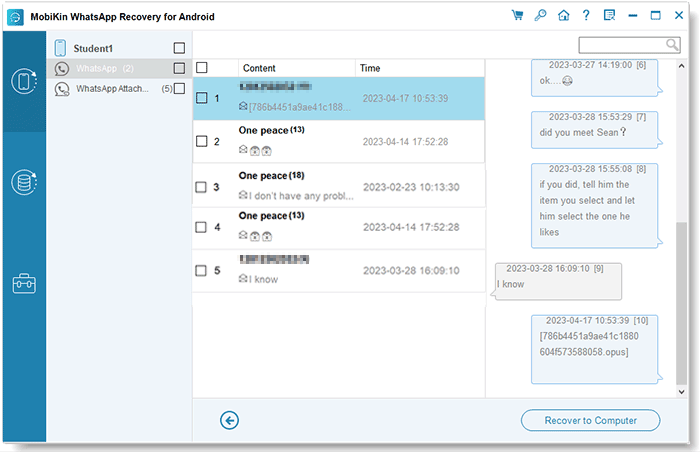
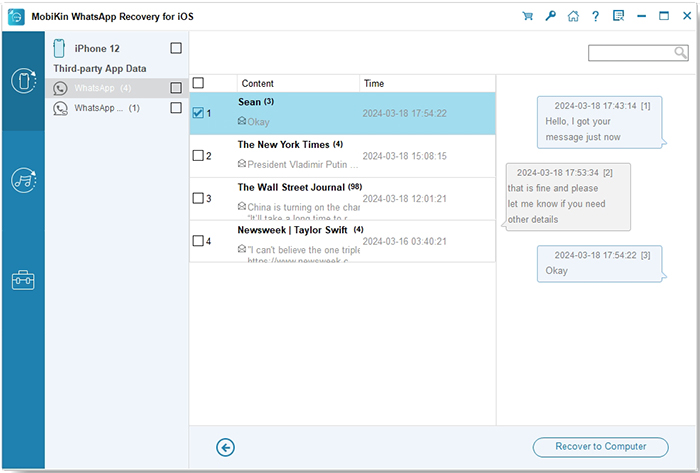
If you want to keep WhatsApp conversations flexible and accessible on a local computer for unexpected needs, consider using MobiKin WhatsApp Recovery for Android or MobiKin WhatsApp Recovery for iOS. These tools allow you to access available WhatsApp data, preview conversations, and export messages and attachments to a computer for easier viewing, backup, and organization.
For Android Users: Using MobiKin WhatsApp Recovery for Android
- Download and install MobiKin WhatsApp Recovery for Android on your computer.
- Select Recovery from Android Device, connect your Android device via USB, and enable USB debugging.
- Follow the on-screen instructions to prepare the backup and scan your WhatsApp data.
- Preview and select the chats and attachments you need.
- Click Recover to Computer to export the selected data.


Video Tutorial:
For iPhone Users: Using MobiKin WhatsApp Recovery for iOS
- Download and install the program on your computer, then connect your iPhone via USB. (Secure Download: Free from ads, unwanted bundles, and background uploads.)
- Select Recover from iOS Device from the left sidebar.
- Choose WhatsApp and WhatsApp Attachments, then click Start Scan.
- Preview the found chats and attachments, select the items you need, and click Recover to Computer to save them locally.
Video Guide:
Why Choose MobiKin WhatsApp Recovery for Android or iOS?
- Local storage: Keep exported WhatsApp conversations on your computer safely.
- Flexible access: Review and organize saved messages more conveniently.
- Selective export: Choose the available conversations and attachments you need.
- Data preservation: Maintain additional copies of important WhatsApp information.
Part 5. Can Deleted WhatsApp Messages Be Used as Evidence in Court?
Yes, deleted WhatsApp messages may still be used as evidence in court if they can be recovered and their authenticity, integrity, and relevance are established. If important conversations have disappeared, you can learn how to recover deleted data from WhatsApp and explore possible recovery methods. However, recovered messages are not automatically admissible, as their acceptance depends on the applicable laws and the evidence presented.
Tips: How to Make Recovered WhatsApp Messages More Useful as Legal Evidence
- Keep recovered files unchanged: Avoid modifying messages or attachments.
- Retain the original phone: Preserve the device whenever possible.
- Document recovery: Record the recovery date, device, and software used.
- Save supporting files: Keep related photos, videos, and backups.
- Maintain storage records: Document where recovered data is stored and accessed.
- Seek professional help: Consider forensic verification and legal advice when necessary.
Part 6. Common Mistakes to Avoid When Using WhatsApp Messages as Court Evidence
Avoid these common mistakes when preparing WhatsApp evidence:
- Submitting cropped screenshots without conversation context.
- Editing messages, timestamps, or screenshots.
- Deleting original conversations or resetting the phone.
- Failing to verify the sender's identity.
- Ignoring relevant surrounding messages.
- Failing to document how evidence was collected.
- Accessing another person's account without authorization.
- Assuming recovered messages are automatically admissible.
- Waiting too long to preserve important conversations.
FAQs about WhatsApp Messages as Court Evidence
Q1. Can WhatsApp voice messages, photos, and videos be used as evidence?
Yes. Voice notes, images, videos, and documents may serve as evidence if they are relevant and their source and integrity can be verified.
Q2. Can I use someone else's WhatsApp messages as evidence?
Possibly, but the way you obtained the messages matters. Unauthorized access to another person's account or private conversations may raise legal and privacy issues. Seek legal advice before collecting or submitting such material.
Q3. Are WhatsApp group chats admissible in court?
Yes. Group chat messages may be used as evidence if they are relevant and their authenticity can be established. Preserve the group name, participants, timestamps, and surrounding conversation.
Q4. Can WhatsApp messages be used without the sender's consent?
Possibly. Consent requirements vary by jurisdiction and how the messages were obtained. Unauthorized access or collection may raise privacy and legal concerns.
Q5. Do WhatsApp messages need to be notarized before being submitted to court?
Not always. Notarization requirements depend on local laws and court procedures. Some cases may require additional authentication or expert verification.
Q6. How long should I keep WhatsApp messages that may be used as evidence?
Keep relevant conversations, attachments, and original devices until the legal matter is fully resolved. Follow any applicable preservation requirements or legal advice.
Q7. Should I hire a digital forensic expert to verify WhatsApp evidence?
It may be helpful in complex or disputed cases. A qualified expert can examine the device, assess message authenticity, and document the extraction process to support the evidence.
Related Articles:
WhatsApp Backup Stuck? Try the 17 Reliable Fixes [2026 Latest]
2026 Latest WhatsApp Viewer Review & the Best Alternative
How to Fix Chat Lock Not Showing in WhatsApp? 7 Effective Ways Here
How to Transfer WhatsApp to New Phone with Same Number/SIM? [2026]